
Proven on our own P&L. Now we sell it.
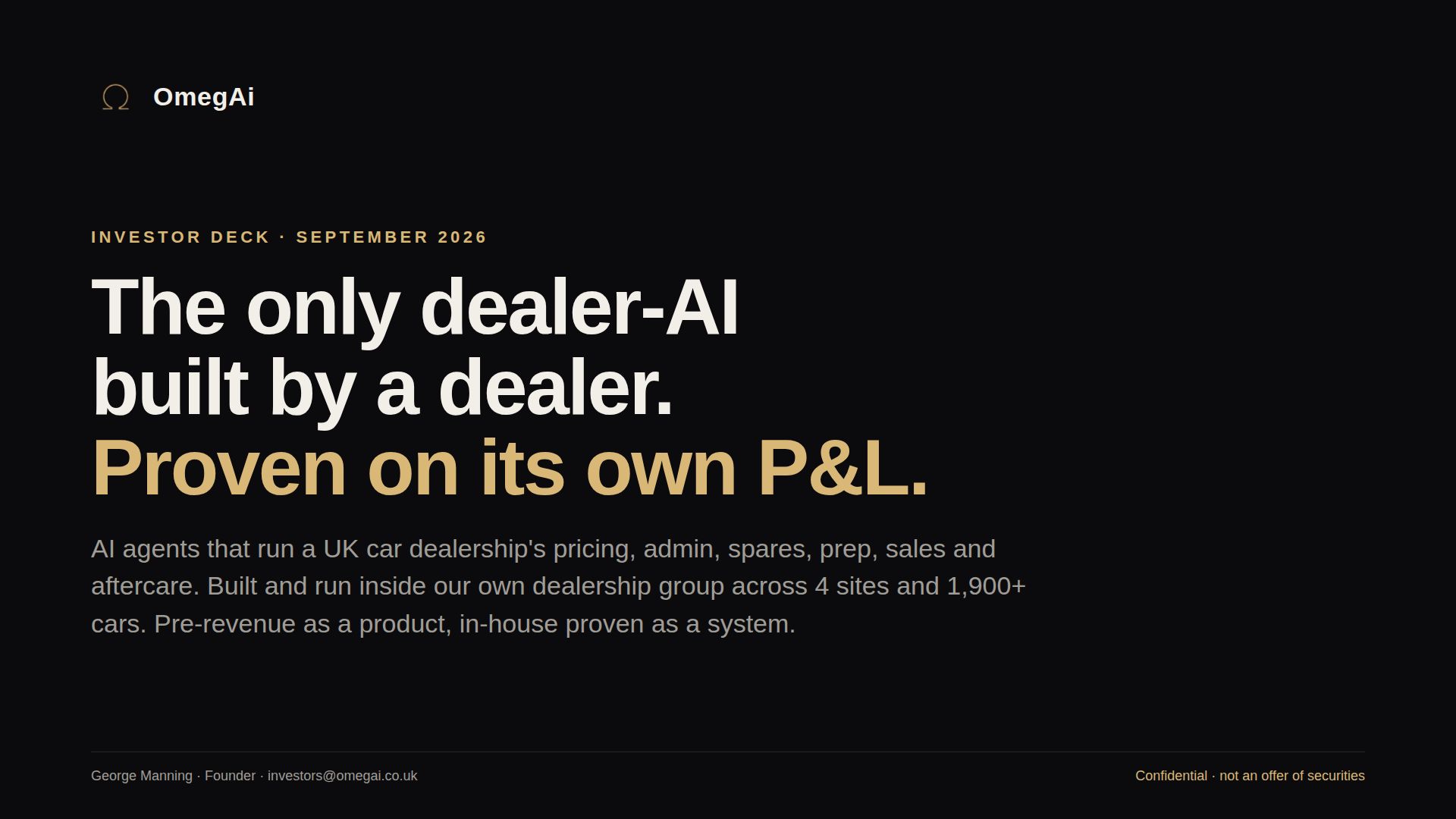
OmegAi is the only dealer-AI built by a dealer, proven on its own profit and loss before selling a single licence. It is pre-revenue as a product and in-house proven as a system. This page sets out the thesis, the numbers we have, the numbers we are planning for, and what we are asking for.
Every dealer-software company has to guess what a dealer needs. We didn't have to guess. George Manning built these agents to run his own four-site, 1,900-car dealership group, and they have run it every day since. The numbers on this site are our own numbers. The product is finished enough to sell because we have been the customer the whole time.
OmegAi is a new brand and a trading name for now; company registration is to follow. Everything financial below is illustrative and labelled as such. We would rather show you a plan you can argue with than a chart that goes up and to the right.
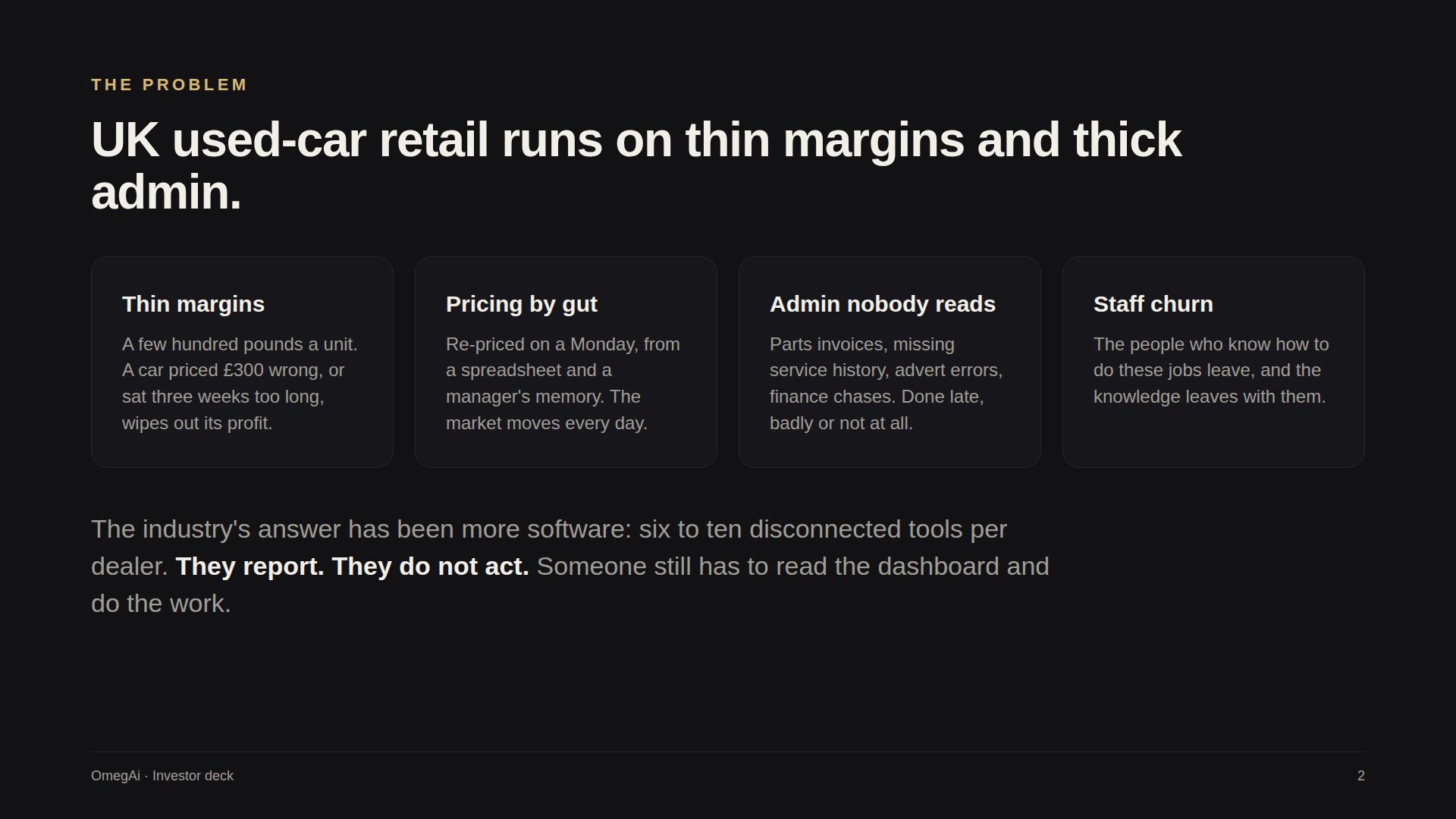
UK used-car retail runs on thin margins and thick admin.
Thin margins
A few hundred pounds a unit after prep, marketing and finance. A car priced £300 wrong, or sat three weeks too long, wipes out the profit on it.
Pricing by gut
Most dealers re-price on a Monday, from a spreadsheet and a manager's memory. The market moves every day.
Admin nobody reads
Parts invoices, missing service history, advert errors, finance chases. It is done late, done badly or not done at all.
Staff churn
The people who know how to do these jobs leave. The knowledge leaves with them and is rebuilt from scratch.
The industry's answer has been more software. A typical dealer pays for six to ten disconnected tools: a DMS, a pricing tool, a stock tool, a CRM, a finance platform, a lead manager, a reporting layer. They report. They do not act. Someone still has to read the dashboard and do the work.
Agents that act, not dashboards.
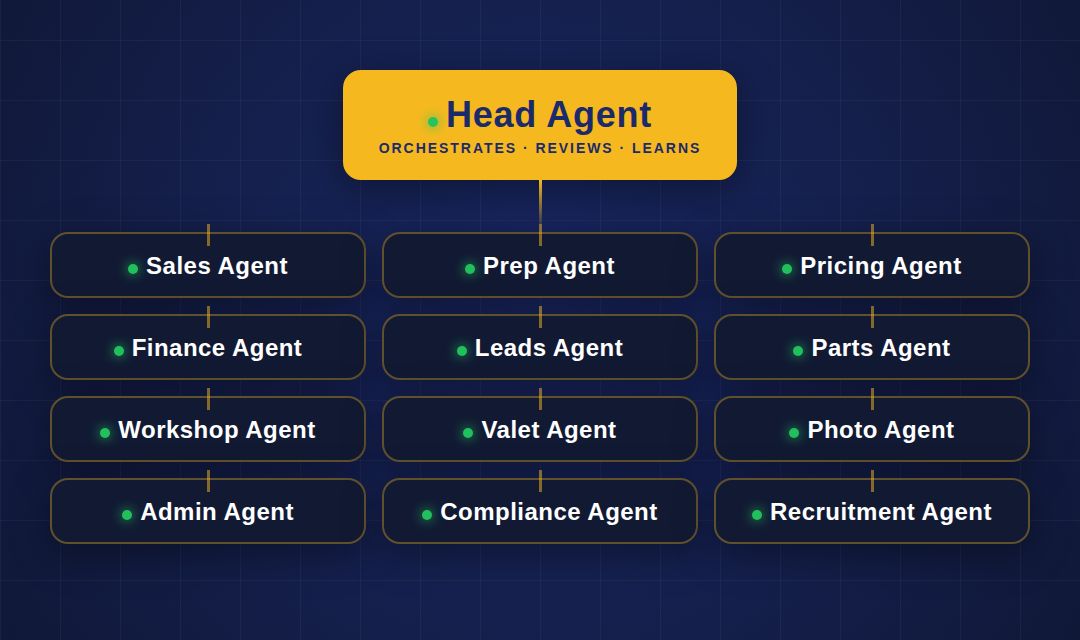
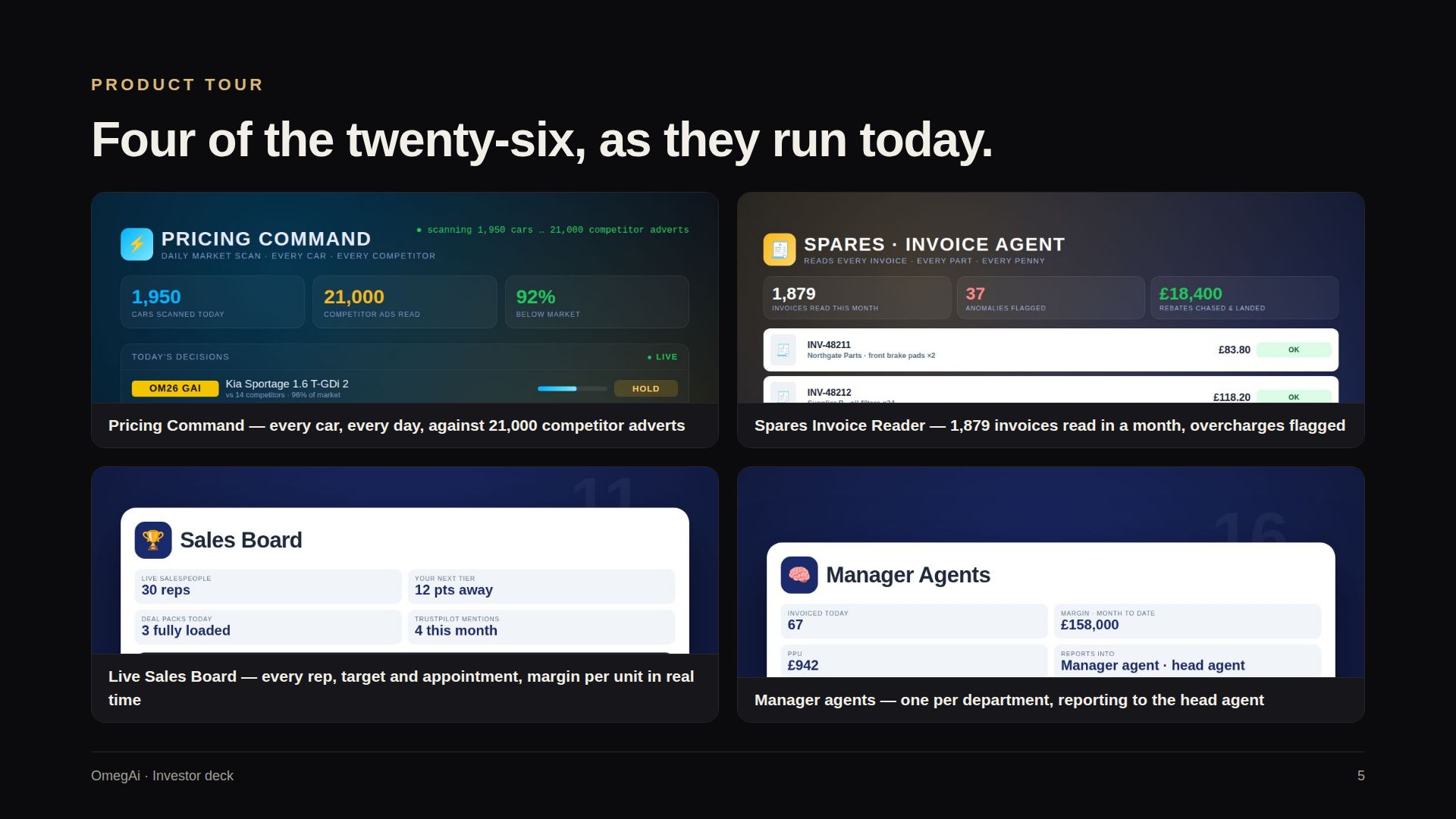
- One head agent, a specialist for every departmentPricing, admin, parts, prep, sales, finance, aftercare, transport, buying. Each does one job well and reports upwards. 26 live agent apps at our own dealership today.
- They do the workThe pricing agent re-prices. The spares agent drafts the credit request. The admin agent fixes the advert. People approve, tighten or loosen what each agent may do on its own.
- A nightly self-improvement loopEvery night the head agent re-scores every deal, price move and process and rewrites the specialists' rules where they produced a poor result. 42,000+ loops so far.
- Sits on top of the DMS and Auto TraderRead from what the dealer already has. Nothing replaced, no migration. Setup in days.
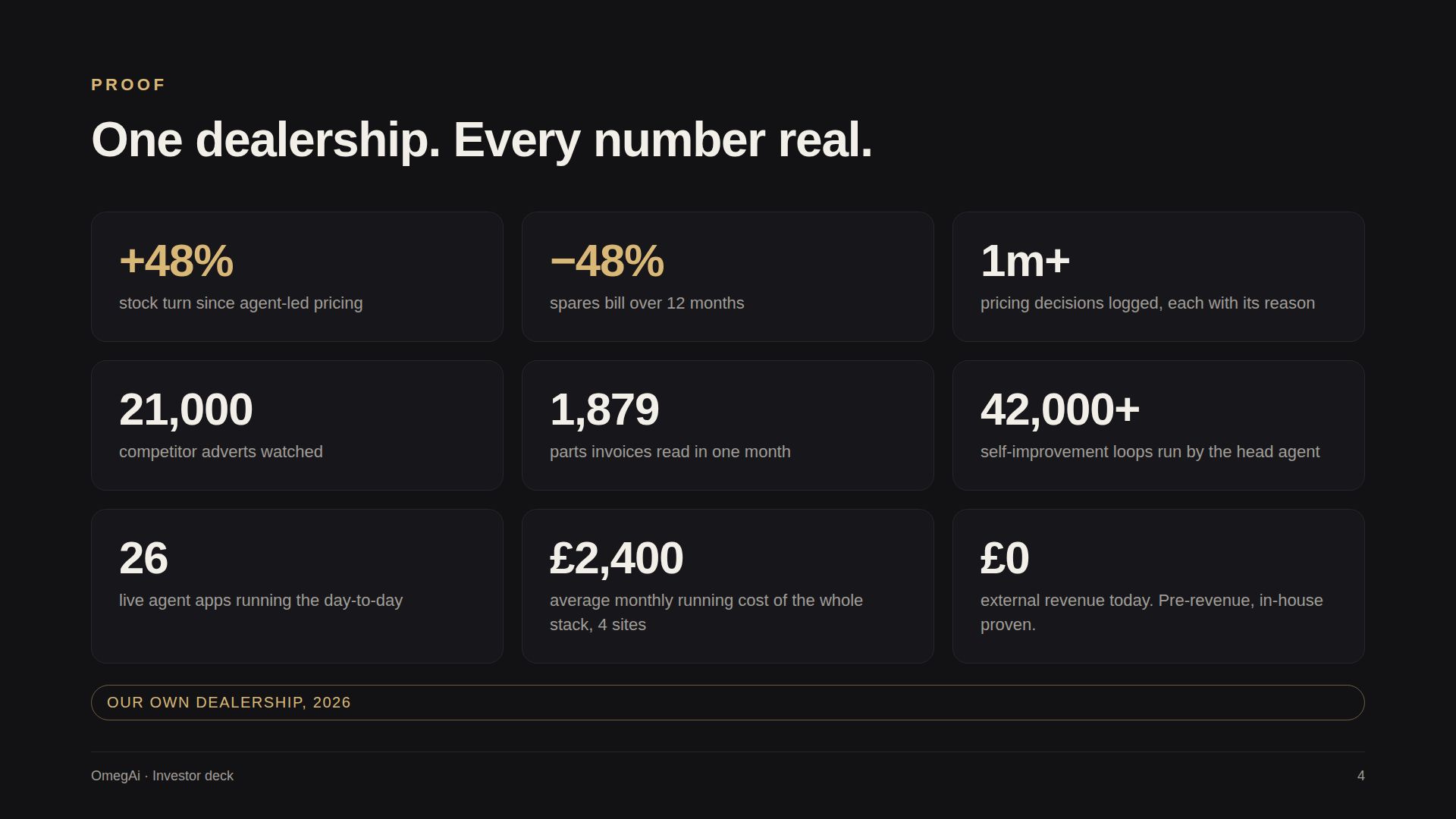
One dealership. Every number real.
We have one case study because we have run this in one business: our own. These are the figures we publish on the results page. We will show the boards behind them in a demo.
stock turn since agent-led pricing went live
spares bill over 12 months
pricing decisions logged, each with its reason
competitor adverts watched
parts invoices read in one month
self-improvement loops run by the head agent
live agent apps running the day-to-day
average monthly running cost of the whole stack, four sites
systems replaced. The DMS and Auto Trader are still the DMS and Auto Trader.
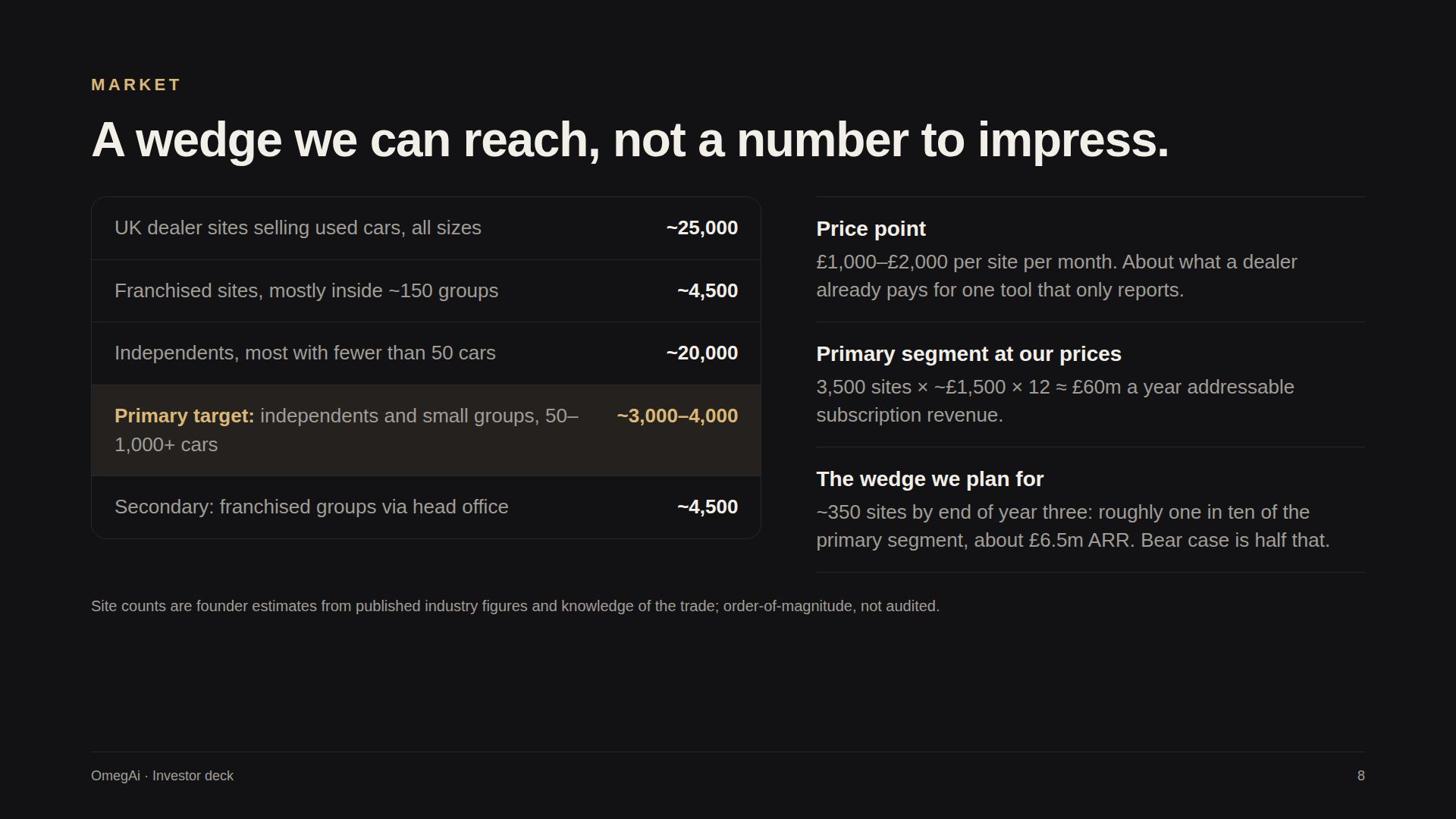
A wedge we can actually reach, not a number to impress.
Site counts are founder estimates from published industry figures and our own knowledge of the trade; treat them as order-of-magnitude, not audited.
- Price point£1,000–£2,000 per site per month, depending on tier and site size. Roughly what a dealer already pays for one of the six to ten tools that only report.
- Primary segment at our prices3,500 sites × ~£1,500 × 12 ≈ £60m a year of addressable subscription revenue. Not a market we expect to own; a market we can sell into one dealer at a time.
- The wedge we plan forAbout 350 sites by the end of year three. That is roughly one in ten of the primary segment, and about £6.5m ARR. The bear case is half that.
- Why independents firstThe owner is the buyer, the buyer is the user, and the decision takes weeks, not a procurement cycle. Franchised groups come later, via head office, once we have case studies they recognise.
A 12–24 month window.
Agent costs have collapsed
Running 26 agents across four sites costs our own dealership about £2,400 a month. Two years ago the same work would have been uneconomic.
DMS vendors are slow
The incumbents ship on annual cycles and sell dashboards. Their customers want the work done. That gap is where we sit.
Auto Trader API access
Dealers can read their own adverts, performance and market data through their own account. That makes a "sits on top" product possible without a partnership first.
Before "AI" ships from incumbents
They will all announce AI. Most will bolt a chat box onto a report. We have a 12–24 month window to have dealers live, referenced and renewing before that.
Setup fee plus a per-site subscription.
- Setup feeCovers connecting systems, writing the dealer's rules and the shadow-mode period. Charged once, per site or per group deal.
- Monthly subscription, per siteCovers the agents chosen, the running costs, the nightly loop and keeping the connections working. Thirty days' notice; no long contract.
- Three tiers by scopeStarter (single site, up to 3 agents), Group (2–10 sites, any agents), Enterprise (10+ sites, full set, own security review). Public pricing is quoted after a demo.
- Unit economicsModel and hosting cost per active site is around £150–£250 a month. At £1,000–£2,000 per site, gross margin is comfortably above 80% before support.
| Modelling assumption | Starter | Group | Enterprise |
|---|---|---|---|
| Subscription, per site per month | £1,200 | £1,800 | £2,500 |
| Setup fee | £5,000 / site | £15,000 / deal | £40,000 / deal |
| Average sites per deal | 1 | 4 | 15 |
These are the base assumptions in the financial model, not a price list. Blended revenue per site in the model is about £1,240 a month in year one (pilot discounts) rising to about £1,580 by year three as the mix shifts toward groups. Illustrative, founder assumptions, September 2026.
Pilots first. Then the case studies do the selling.
3–5 pilot dealers
The first is a known dealer contact. Priced to convert, run in shadow mode then live, with before-and-after numbers we can publish with their permission.
Case studies, trade press, groups
Published pilot results. Dealer trade press and events. Direct approach to small groups where one decision covers several sites.
Channel and partners
Partnership or channel with a DMS vendor or Auto Trader once we have volume that makes us worth integrating, not before.
What is hard to copy.
Built inside a real dealer
Every agent has been corrected by real staff on a real forecourt until it stopped needing correcting. That took weeks per agent and it is not in any public dataset.
Proprietary rule sets
42,000+ learning loops have produced rules about what "slow stock" means for each type of car, when to cut, when to hold, which invoice lines are usually wrong. The rules are the product.
Data network effects
Each dealer runs in isolation, but the patterns the head agent learns about the market, suppliers and pricing improve the rule sets every dealer starts from.
Speed of deployment
Days, not months, because nothing is replaced. A DMS vendor cannot easily offer that without cannibalising their own migration revenue.
The founder is the customer
George runs a dealership. He knows what a bad month feels like and what a dealer will actually pay for. Product decisions do not go through a focus group.
Low running cost
A whole four-site stack for about £2,400 a month. Incumbents carry the cost of legacy platforms and sales teams; we do not.
The honest list, with what we are doing about each.
Auto Trader dependency
Pricing and market data lean on Auto Trader access through the dealer's own account. Terms or access could change.
Dealer-owned access rather than a partnership we could lose. Several agents (spares, admin, prep, sales, finance) do not depend on it. Partner-status conversation planned once we have volume.
Incumbents ship "AI"
Keyloop, Pinewood, CDK and Auto Trader all have distribution we do not.
Speed and proof. Live, renewing dealers with published numbers inside the 12–24 month window. Agents that act are a different product from a chat box on a report, and dealers can tell the difference on day one.
Model cost and price changes
We rent the underlying models. Prices and availability move.
Cost per site is modelled at £150–£250 against £1,000–£2,000 revenue, so a doubling of model cost is absorbed. Agents are model-agnostic; we already run more than one provider.
Key person
George built the stack and runs a dealership. That is the moat and the risk.
First hires are a CTO / lead engineer and a head of dealer onboarding. Documentation of rule sets and architecture is part of the pilot phase. IP assignment from the founder's dealership group to OmegAi is on the data-room list.
Support scaling
Every dealer has habits and exceptions that are not written down. Tuning took weeks at our own dealership.
Shadow mode before live. Per-site onboarding cost is in the model (£3,500). Headcount in onboarding grows ahead of sites. The nightly loop reduces manual tuning over time.
Data and GDPR
Dealer and customer data, call audio with consent, per-dealer processing agreements.
UK hosting, one environment per dealer, personal data masked before any model call, no pooling, no training for others. Written processor terms per dealer. Security and GDPR summary is on the data-room list.
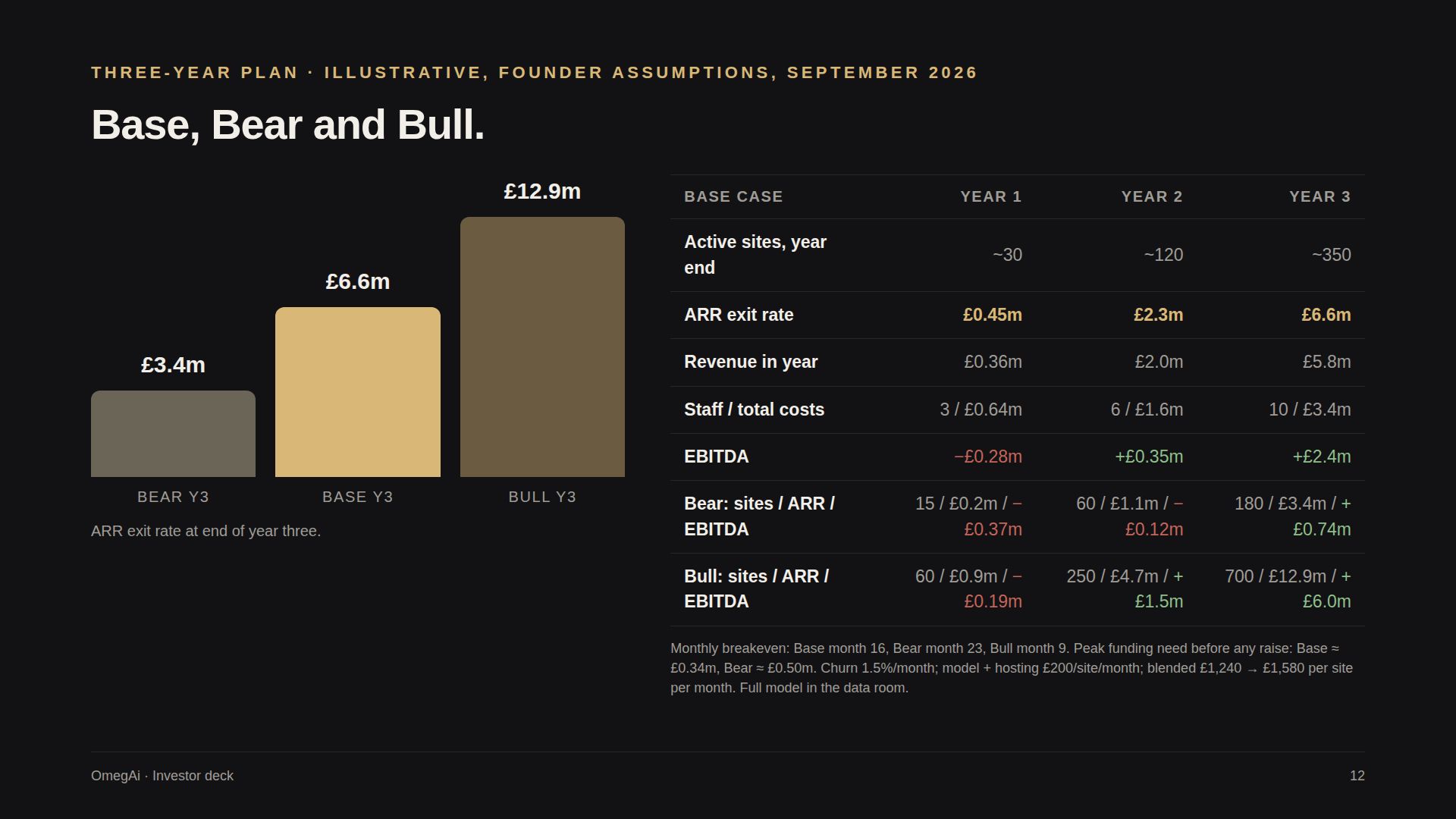
Base, Bear and Bull. All illustrative.
Monthly model, 36 months, 1.5% monthly churn, three staff in year one rising to six then ten. The full model is downloadable below and every input is editable. Illustrative, founder assumptions, September 2026.
Year 1 — ARR exit rate
Year 2 — ARR exit rate
Year 3 — ARR exit rate
| Base case | Year 1 | Year 2 | Year 3 |
|---|---|---|---|
| Active sites at year end | ~30 | ~120 | ~350 |
| ARR exit rate | £0.45m | £2.3m | £6.6m |
| Revenue in year (subscription + setup) | £0.36m | £2.0m | £5.8m |
| Staff (year end) | 3 | 6 | 10 |
| Staff cost, fully loaded | £0.28m | £0.52m | £0.81m |
| Model + hosting (~£200 per site per month + platform) | £0.05m | £0.20m | £0.58m |
| Onboarding, commission, contractors | £0.22m | £0.70m | £1.6m |
| Sales & marketing + overheads | £0.08m | £0.18m | £0.34m |
| Total costs | £0.64m | £1.6m | £3.4m |
| EBITDA | −£0.28m | +£0.35m | +£2.4m |
| Monthly EBITDA breakeven | Month 16. Peak funding need before any raise ≈ £0.34m. | ||
| Scenarios | Year 1 | Year 2 | Year 3 | Breakeven |
|---|---|---|---|---|
| Bear — sites | ~15 | ~60 | ~180 | Month 23 peak need ≈ £0.50m |
| Bear — ARR / EBITDA | £0.2m / −£0.37m | £1.1m / −£0.12m | £3.4m / +£0.74m | |
| Base — sites | ~30 | ~120 | ~350 | Month 16 peak need ≈ £0.34m |
| Base — ARR / EBITDA | £0.45m / −£0.28m | £2.3m / +£0.35m | £6.6m / +£2.4m | |
| Bull — sites | ~60 | ~250 | ~700 | Month 9 peak need ≈ £0.19m |
| Bull — ARR / EBITDA | £0.9m / −£0.19m | £4.7m / +£1.5m | £12.9m / +£6.0m |
Key assumptions: blended subscription £1,240 → £1,520 → £1,580 per site per month across the three years (tier mix shifting from Starter toward Group and Enterprise, 10% pilot discount in year one); setup revenue ~£4,100–£4,600 per new site; churn 1.5% a month; model + hosting £200 per active site per month plus £1,500 a month fixed; onboarding £3,500 per new site; 10% sales commission on first-year contract value; 20% employer on-costs; sales & marketing £4k → £10k → £20k a month. Bull case hires earlier, Bear case hires six months later. No VAT, tax, interest or depreciation. Illustrative, founder assumptions, September 2026.
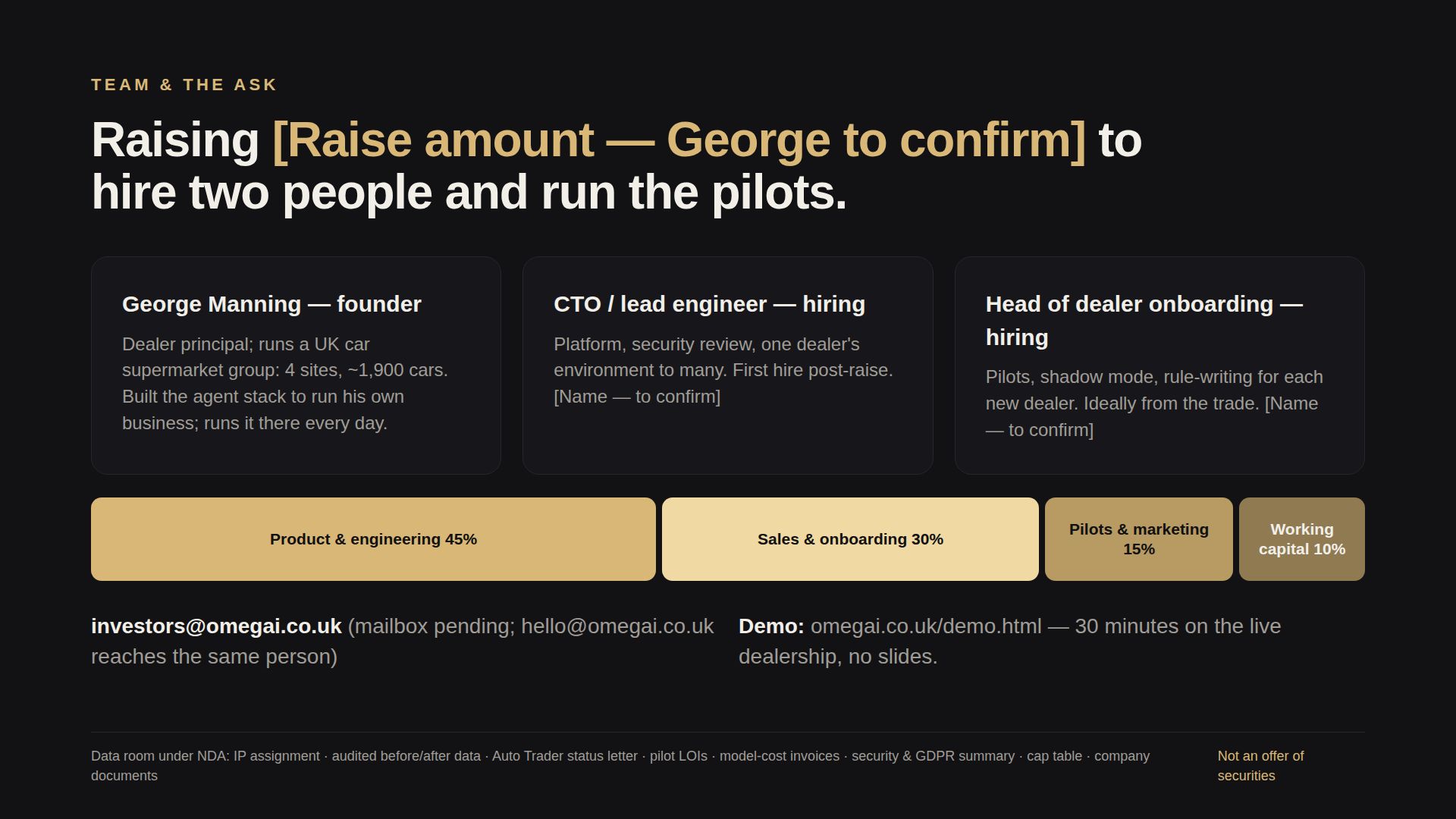
Raising [Raise amount — George to confirm].
Suggested split. Enough to hire the first two people, run the pilots properly and reach monthly breakeven in the base case with a margin for the bear case.
Valuation, instrument and timing: to be confirmed by George. Peak funding need in the model before any raise is roughly £0.34m in the base case and £0.50m in the bear case; the raise should cover the bear case with headroom.
One founder who is also the customer. Two hires to make.
George Manning — founder
Dealer principal; runs a UK car supermarket group with four sites and around 1,900 cars in stock. Built the agent stack to run his own business, and runs it there every day.
CTO / lead engineer — hiring
Owns the platform, security review and the move from one dealer's environment to many. First hire post-raise. [Name — to confirm]
Head of dealer onboarding — hiring
Runs the pilots, the shadow-mode period and the rule-writing for each new dealer. Ideally from the trade. [Name — to confirm]
What we will show you under NDA.
- IP assignmentThe founder's dealership group → OmegAi, covering the agent stack, rule sets and brand.
- Audited before/after data from our own dealershipStock turn, spares spend, pricing logs, with the accountant's sign-off.
- Auto Trader partner status letterCurrent account and API access position, in writing.
- Pilot LOIsLetters of intent from the first pilot dealers as they are signed.
- Model-cost invoicesTwelve months of provider invoices behind the £2,400 a month figure.
- Security and GDPR summaryHosting, isolation, masking, processor terms, retention.
- Cap tableCurrent and post-raise.
- Company documentsThe dealership group's accounts, OmegAi incorporation plan, board and shareholder documents.
Fourteen slides. Same numbers as this page.
Talk to the person who built it.
We are raising [Raise amount — George to confirm] to hire two people, run three to five pilots and get to renewing, referenced dealers inside the window. If you invest in UK software or in the motor trade, we would like thirty minutes.
Mailbox pending; until it is live, [email protected] reaches the same person.
See it running
A 30-minute screen-share on the live dealership. No slides: the boards, the agents at work and the numbers behind them.
This page is for information only and is not an offer of securities. Figures marked illustrative are founder assumptions as at September 2026 and will change. Dealership figures are from our own operation and will be evidenced in the data room.